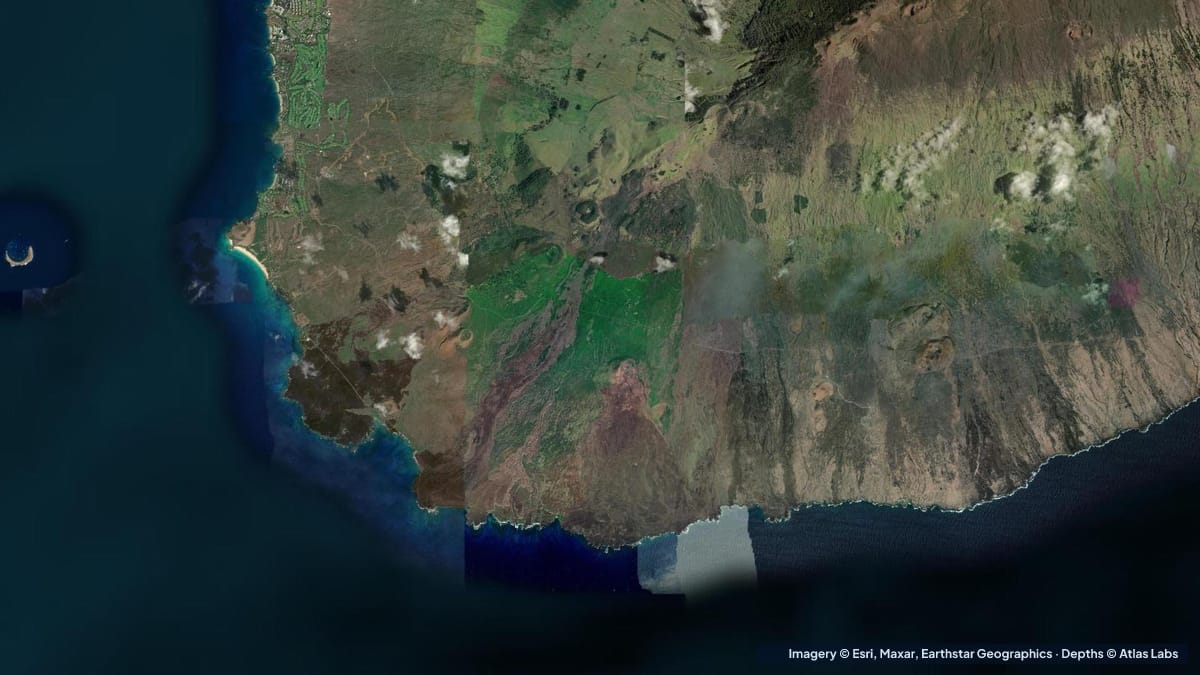
Molokini is the crescent-shaped rim of a drowned volcanic crater about 3 miles (5 km) off Maui’s south-west coast, a state marine life conservation district where boats moor inside the crescent and snorkelers float over a sunlit reef in some of the clearest water in Hawaii. Visibility is routinely 100 ft (30 m) or more. On the outside, the Back Wall drops hundreds of feet into the blue. Along the Maui shore opposite, from Makena to Ahihi Kinau, a string of lava-rock points and coral reefs gives easy shore snorkeling and kayaking in much shallower water. This guide covers typical depths for all of it, how to get there, conditions and hazards. The satellite depth map for this cell is updated regularly.
What the bottom looks like
- Inside Molokini Crater: a sheltered, bowl-shaped reef of hard coral on a gentle slope from the inner rim down to a sand floor, with reef fish in huge numbers. Boats use fixed moorings; no anchoring.
- The Back Wall (outer side): a sheer volcanic cliff continuing underwater, dropping from the surface to roughly 300 ft (90 m) and beyond, with pelagics and strong current. Advanced snorkelers and divers only.
- Makena Landing and Turtle Town (Maluaka): lava-rock points and coral gardens in shallow water along the Makena coast, famous for green turtles; a gentle sandy entry at Makena Landing.
- Ahihi Kinau Natural Area Reserve: a lava-rock coast south of Makena with clear, shallow coral coves (the Ahihi Cove and the Dumps area), with restricted access to protect the reef.
- Big Beach (Oneloa) and Little Beach: steep sand beaches with strong shorebreak and no reef; swimming, not snorkeling.
- The Alalakeiki Channel between Maui and Molokini and Kahoolawe: deep, windy and rough by midday.
Approximate depth by zone
Typical ranges only. The tide range is small, about 1 to 2 ft (0.3 to 0.6 m); swell and wind matter more. Check the live map.
- Inside Molokini, snorkel area: descriptions range from roughly 10 to 70 ft (3 to 21 m), with most snorkeling over reef in roughly 20 to 30 ft (6 to 9 m) and the mooring spots in roughly 20 to 50 ft (6 to 15 m).
- Inner rim shallows: roughly 5 to 15 ft (1.5 to 4.6 m) close to the crater wall.
- The Back Wall: from the surface to roughly 300 ft (90 m) and deeper within a few boat lengths of the rock.
- Makena Landing and Turtle Town: roughly 5 to 25 ft (1.5 to 7.6 m) over coral and sand.
- Ahihi Cove: roughly 3 to 15 ft (0.9 to 4.6 m), very clear.
- Alalakeiki Channel: hundreds of feet.
Access, launches and moorings
- Molokini: by permitted tour boat only, from Maalaea Harbor and Kihei Boat Ramp, usually departing early morning for the calmest conditions; moorings inside the crater are fixed and limited.
- Kihei Boat Ramp: the public ramp on South Maui for private boats and the smaller Molokini operators; busy before dawn.
- Maalaea Harbor: the main harbour for the larger snorkel boats.
- Makena Landing Park: free parking, a small sandy beach and an easy kayak and snorkel launch; kayak tours to Turtle Town leave from here.
- Maluaka Beach: parking and a sandy entry for the Turtle Town reef.
- Ahihi Kinau: limited roadside parking and strict rules; parts of the reserve are closed.
Best tide, wind and season
- Tide: Minor. Go early. The trade wind reaches Molokini by late morning and the afternoon crossing back to Maui is rough.
- Wind: Trade winds from the north-east wrap around Haleakala and accelerate across the channel from mid-morning; the inside of the crater stays calm longer than the channel. South Maui’s shore reefs are sheltered in the morning and choppy by noon. Kona (southerly) winds in winter reverse this and can close Molokini for the day.
- Season: All year. Winter (December to March) adds humpback whales to the crossing and occasional south swells; summer has the steadiest conditions and the warmest water. Weekday mornings are quietest.
Hazards
- Current at the crater mouth and the Back Wall: Current sweeps across the open side of the crescent and along the outer wall; stay inside the mooring area unless on a guided drift.
- Deep water and crowds inside the crater: Even the shallow snorkel area is 20 ft (6 m) or more; weak swimmers should use a flotation aid and stay near the boat.
- Shorebreak at Big Beach: Dangerous, with regular injuries; not a snorkel beach.
- Lava rock and urchins: Entries at Ahihi and Makena are rocky; wear reef shoes and enter on sand where possible.
- Boat traffic at Makena Landing: Kayak tours and dive boats share the small cove.
- Protected area rules: No fishing or collecting at Molokini or Ahihi Kinau; no touching turtles or coral anywhere.
Kayak and paddleboard guidance
Kayaks and paddleboards (4 to 6 in, 10 to 15 cm of draft) are perfect for the Makena coast in the morning: launch at Makena Landing and paddle south over Turtle Town’s reefs in 5 to 25 ft (1.5 to 7.6 m), snorkeling from the boat. Do not attempt to paddle to Molokini; the channel is deep, windy and crossed by fast boats.
Private boats visiting Molokini must use the fixed moorings inside the crater, which are limited and often fully booked by permitted operators; anchoring is prohibited.
Frequently asked questions
How deep is Molokini Crater inside?
Most snorkeling is over reef in roughly 20 to 30 ft (6 to 9 m), with the inner rim shallower and the mooring area roughly 20 to 50 ft (6 to 15 m). Descriptions of the full snorkel zone range from 10 to 70 ft (3 to 21 m).
How deep is the Molokini Back Wall?
It drops from the surface to roughly 300 ft (90 m) and deeper within a few boat lengths. It is for advanced snorkelers and divers on guided drifts only.
Can I snorkel to Molokini from Maui?
No. It is about 3 miles (5 km) across a deep, windy channel. Go by permitted tour boat from Maalaea or Kihei.
Where is the best shore snorkeling near Molokini?
Makena Landing and Turtle Town (Maluaka) for turtles in 5 to 25 ft (1.5 to 7.6 m), and Ahihi Cove for very clear shallow coral.
When is the best time to snorkel Molokini?
Early morning, before the trade wind builds, on a weekday, any month of the year.
Related reading
Safety note: ShoalScope depth maps are satellite estimates for planning only and are not for navigation. Molokini’s open side and Back Wall have strong current. Follow your captain’s briefing and conservation district rules, and never snorkel alone.