Florida Bay is one of the great shallow-water fisheries in the world, and one of the easiest places in Florida to run a boat aground. Almost the entire bay is a maze of mud banks and grass basins, with a few natural channels and deeper “lakes” between them. A good chart helps; seeing the whole pattern from above helps more. This guide reads our live depth map of the bay off Flamingo, in Everglades National Park.
Depths are at low tide. This map has a typical error of about 3 ft, which, in a bay this shallow, means one thing: use it to see where the channels and deeper lakes are, not to read an exact number on a bank.
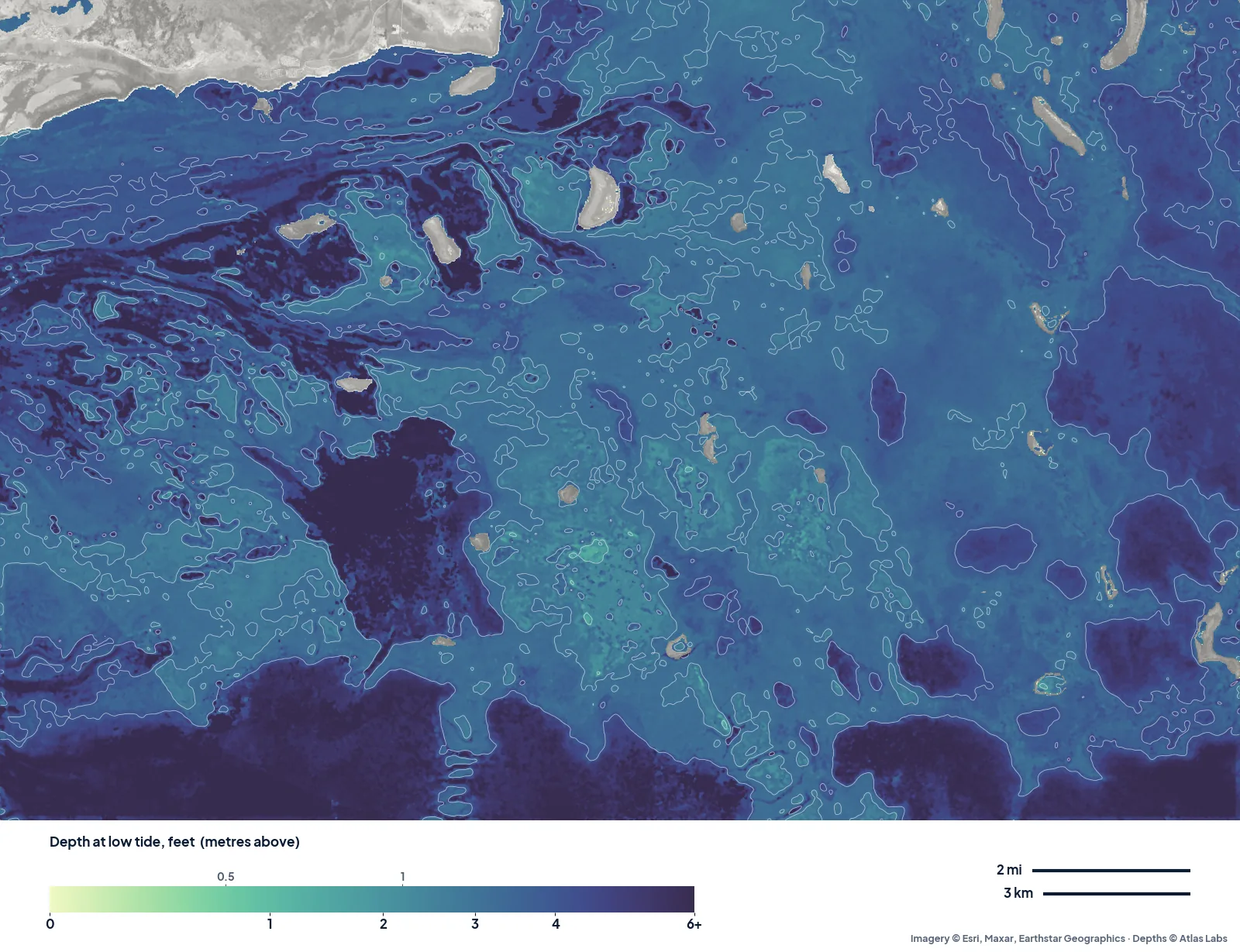
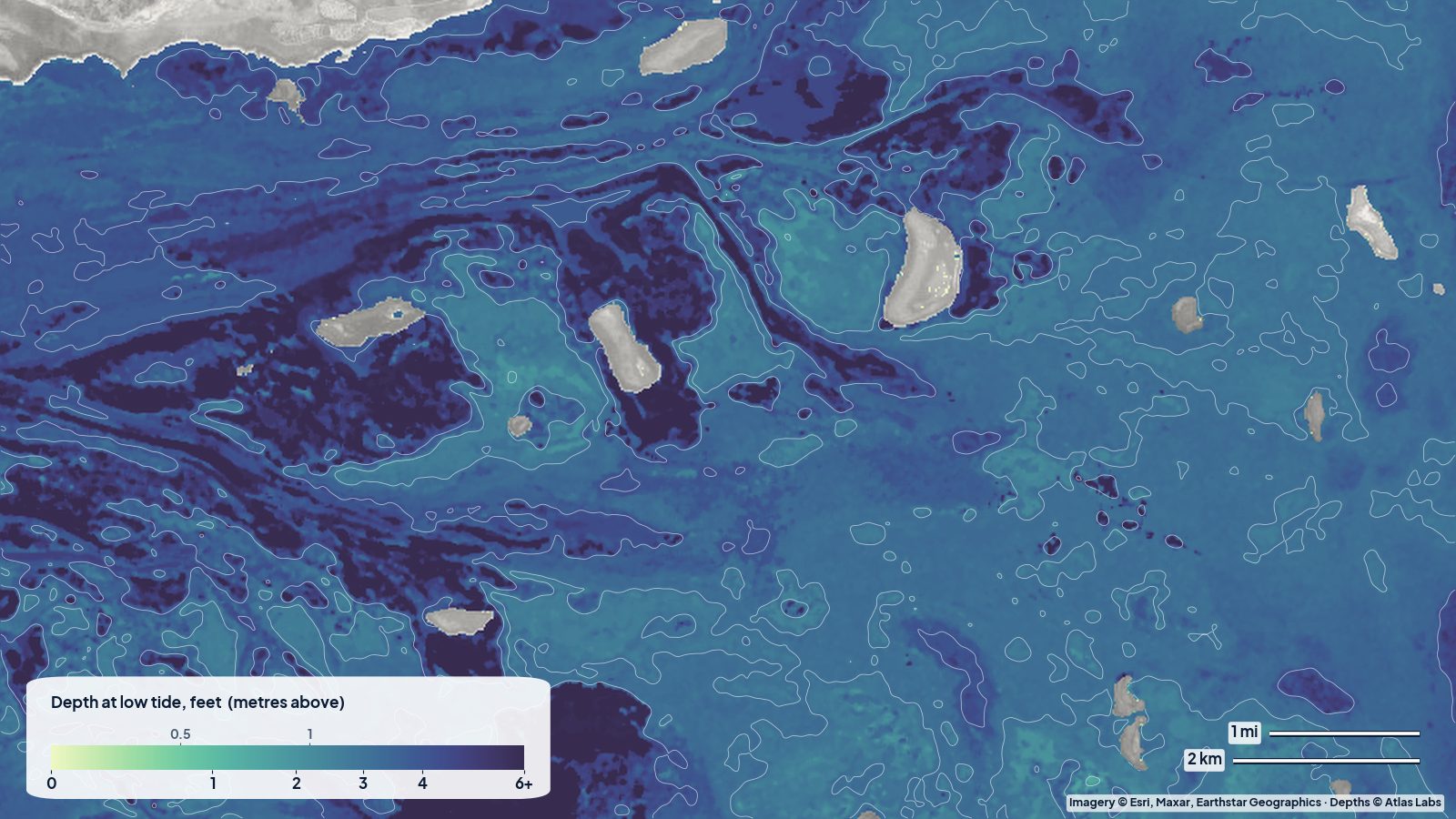
Florida Bay off Flamingo at low tide. Note the colour scale only runs to 6 ft. The darker winding lines are the channels and deeper lakes between the banks.
How shallow is Florida Bay?
Very. On our map, more than eight in ten of the mapped water off Flamingo reads 2 to 5 ft at low tide, and the middle of the open bay reads about 3 ft. Nothing in this part of the bay reads deeper than about 6 to 7 ft. That is why the colour scale on this map stops at 6 ft: any deeper scale would turn the whole bay into one flat colour.
Real banks get much shallower than the map’s average: many go almost dry on a spring low, especially after a north wind pushes water out of the bay.
Where the channels are
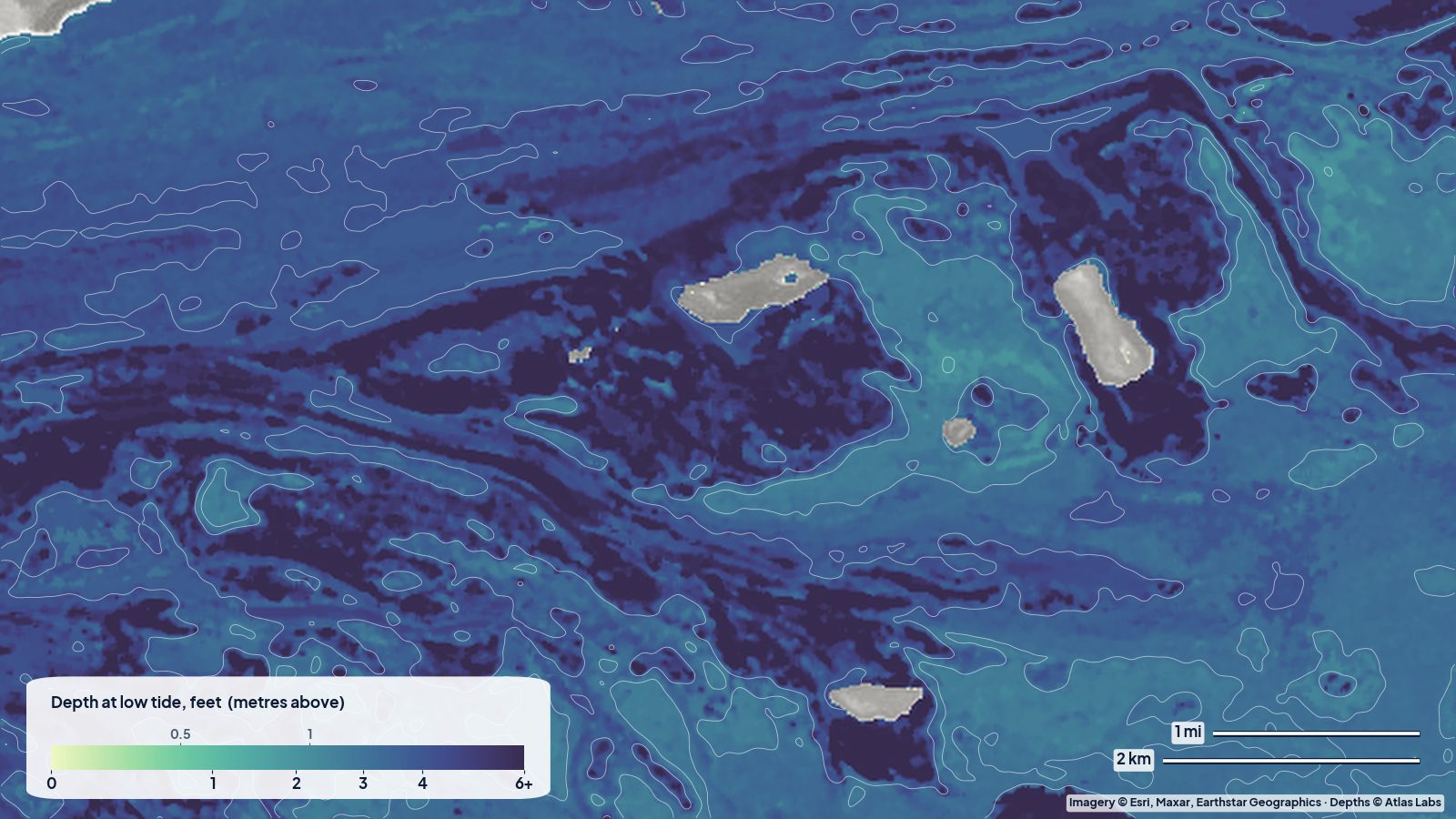
The useful part of the map is the pattern of darker water. West of Flamingo, a set of winding, darker lines runs roughly east–west between the banks; these are the natural channels and deeper troughs that guides use to move around the bay. Further out you can see rounded, darker basins (the “lakes”) surrounded by paler banks.
The approach to Flamingo itself reads around 4 ft on the map, and Snake Bight, east of Flamingo, reads an even 3 ft across most of its area, shallower toward the mangrove shore.
Planning a day on the bay
- Draft first. A technical poling skiff drawing 8 to 10 in can work most of the bay on a mid tide; a bay boat drawing 18 in should stick to the channels and the deeper lakes.
- Plan your exit before the tide does. The big mistake in Florida Bay is poling onto a bank on a falling tide and finding that the way out has dried. Pick a channel on the map before you leave it.
- Wind matters as much as tide. A strong north or north-east wind can drop the bay noticeably below the predicted tide; a south wind brings water in.
- Slow down over the banks. Prop scars in seagrass take years to heal. Parts of the bay are pole-and-troll or idle zones; check the national park’s current maps and rules before you go, including any boater education requirement.
- Kayaks: the shallow banks are kayak paradise, but distances are long and there is no shade. Carry water and a plan for wind on the return.
When to go
Winter (December to April) brings cooler, clearer days between fronts, and is the main season for visitors. Summer is hot and glassy in the mornings, with storms and mosquitoes in the afternoon. Water clarity changes a lot with wind; a calm morning after a few settled days is the best time to see the bottom.
Open the live map
Tap any spot for the depth in feet: Florida Bay and Flamingo live map. For launch ramps and spot details see the full Florida Bay and Flamingo guide, and for the region the Florida Bay and Everglades spot hub.
Frequently asked questions
How deep is Florida Bay?
Off Flamingo, our map reads most of the bay at 2 to 5 ft at low tide, with the middle around 3 ft and the channels and lakes a little deeper. Many banks are shallower than that at low water.
Can a bay boat fish Florida Bay?
Yes, in the channels and deeper lakes, on a rising or high tide. The open banks are poling-skiff and kayak water.
How deep is Snake Bight?
Our map reads about 3 ft across most of it at low tide, shallower toward the shore.
Related reading
- Florida Bay and Flamingo depth map
- How shallow are the Florida Keys flats?
- Ten Thousand Islands depth map for kayaks
Safety note: ShoalScope depth maps are satellite estimates for planning, not for navigation. Use official charts and park maps, tell someone your plan, and always wear a life jacket.